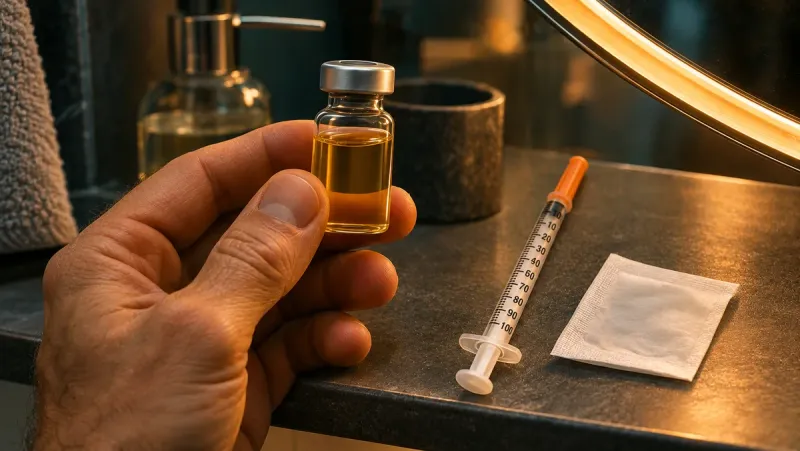
Testosterone Cypionate vs Enanthate: Differences, Half-Life, Dosing and Which to Choose
Testosterone cypionate vs enanthate is the comparison every man on injectable TRT eventually makes, usually when a pharmacy swaps one for the other or a clinic abroad prescribes the one he has not heard of. The two are the same hormone with two different fatty-acid chains attached, and the practical differences come down to the oil, the preservative, the half-life and the package.
This article compares them on what the labels say, what the published pharmacokinetics show, how prescribers dose each one, and which to choose when there is a choice. The facts come from the Depo-Testosterone label (Pfizer, revised September 2025), the generic testosterone enanthate injection label, the Xyosted label (Antares) and the pharmacokinetic literature cited below.
Key takeaway: cypionate and enanthate are interchangeable in practice. Both are 200 mg/mL esters, both are dosed 50 to 400 mg every two to four weeks on the label and 75 to 100 mg weekly in the Endocrine Society regimen. Cypionate comes in cottonseed oil with benzyl alcohol and dominates US prescriptions; enanthate comes in sesame oil with chlorobutanol, dominates Europe, and is the ester in the Xyosted subcutaneous autoinjector. The half-life difference is days at most and disappears on a weekly schedule.
What the Two Esters Are
Testosterone itself lasts minutes in the blood; the enanthate label puts its half-life at 10 to 100 minutes. An ester is a fatty-acid chain bonded to the 17-beta hydroxyl group of the molecule, which makes it oil-soluble, lets it sit in a muscle depot and releases free testosterone as enzymes clip the chain off.
The two molecules
Ester chain
Cyclopentylpropionate, 8 carbons
Heptanoate, 7 carbons
Molecular weight
412.6
400.6
Testosterone per 200 mg
About 140 mg
About 144 mg
Initial US approval
1953 (per the Azmiro label)
1953 (per the Xyosted label)
The one-carbon difference in the chain is why the two behave so alike: both are cleared over about a week, and the amount of actual testosterone in a 200 mg dose differs by a few milligrams. The chemistry and the dose arithmetic for the cypionate side are on the overview page.
What Is in the Vial
The differences a user can actually feel are in the excipients, not the hormone.
Vial contents, per the labels
Strength
100 or 200 mg/mL
200 mg/mL
Carrier oil
Cottonseed oil
Sesame oil
Preservative
Benzyl alcohol 9.45 mg/mL
Chlorobutanol 5 mg/mL
Solvent
Benzyl benzoate
None listed
Vial
1 mL and 10 mL
5 mL multi-dose (1,000 mg)
Two consequences follow from that table. A man allergic to sesame cannot use enanthate, and the Xyosted label lists sesame oil as a contraindication for that reason; cottonseed oil allergy is rarer but the same logic applies to cypionate. And the sesame oil formulation without benzyl benzoate is slightly thicker in a cold vial, which is why some users report that enanthate draws more slowly through a fine needle.

Half-Life and the Shape of the Curve
The Depo-Testosterone label states a half-life of approximately eight days after intramuscular injection. The enanthate label gives no half-life figure; it says only that injections more often than every two weeks are rarely indicated and that total doses above 400 mg a month are not needed.
The published literature narrows the gap further. A 2020 review in the American Journal of Men's Health tabulates the half-life of enanthate at 4.5 days and cypionate at 4 days, and a 2022 systematic review in Endocrine Connections found that hardly any head-to-head comparative studies of the preparations have been done. The honest reading is that the two esters are cleared over a similar span, within days of each other, and that the eight-day label figure for cypionate describes the slow tail of the curve rather than a clinically different drug.
The chart is a schematic. Both curves peak within the first three days, the Azmiro study measured a median 72-hour peak for 200 mg of cypionate, and both are back near baseline by two weeks. On a weekly schedule the curves overlap almost completely, which is why neither the Endocrine Society guideline nor the labels distinguish between them in the dose tables.
Dosing: Labels and Guidelines
How each ester is dosed
Label, male hypogonadism
50 to 400 mg every 2 to 4 weeks, intramuscular
50 to 400 mg every 2 to 4 weeks, intramuscular
Endocrine Society 2018
75 to 100 mg weekly or 150 to 200 mg every 2 weeks
Same
FDA-approved subcutaneous
None
Xyosted 50, 75 or 100 mg weekly into the abdomen
Classic trial regimen
Azmiro: single 200 mg dose, mean peak 758 ng/dL
Snyder and Lawrence 1980: 100 mg weekly to 400 mg every 4 weeks
The 1980 enanthate trial is worth knowing because it is the origin of the "200 mg every two weeks" habit: in 23 hypogonadal men, 200 mg every two weeks and 300 mg every three weeks suppressed LH to normal with the fewest injections, while 400 mg every four weeks did not. The same trial found the steadiest average testosterone on 100 mg weekly, which is where guidelines settled forty years later.
In practice a prescriber writes the dose in milligrams and the pharmacy fills whichever ester it stocks. The labels say injectable testosterone products are not substitutable milligram for milligram, which is a formal caution; clinics switching a stable patient from one to the other at the same dose and interval rarely change anything but the vial. How a weekly or twice-weekly schedule is set up is in the TRT guide.
Subcutaneous Injection
Only enanthate has an FDA-approved subcutaneous product. Xyosted delivers 50, 75 or 100 mg of testosterone enanthate in sesame oil from a single-dose autoinjector into the abdominal fat once a week; its label reports a median peak 11.9 hours after the dose and steady state by week six, with the dose adjusted to keep the trough between 350 and 650 ng/dL.
Cypionate is injected subcutaneously off label, and widely: a 2017 academic clinic cohort of 63 men on weekly subcutaneous cypionate or enanthate found every patient in the normal range and the route preferred by all 22 men who switched from intramuscular. The technique and the needle sizes are in the injection guide; the point for this comparison is that the route works with either ester, and only one of them has a label that says so.
Availability and Price
Cypionate is the US injectable. Pfizer, Azurity and more than a dozen generic makers list 200 mg/mL cypionate on DailyMed, and a generic 1 mL vial cost $13 to $30 with a pharmacy coupon in November 2026. Enanthate is sold in the US as a generic 5 mL multi-dose vial from fewer makers, and as the branded Xyosted autoinjector, which costs many times more per dose than either vial.
Outside the United States the balance flips. Enanthate is the standard injectable ester in Europe and much of Asia, and a man moving between countries will often be switched for no reason other than stock. The US makers, package sizes and prices for cypionate are on the products page.

Which One to Choose
For a man with a choice, the decision usually rests on four things:
- 1Allergy: sesame rules out enanthate; a cottonseed sensitivity rules out cypionate.
- 2Route: a prescriber who wants an approved subcutaneous product chooses Xyosted, which is enanthate.
- 3Supply and price: in the US, cypionate is cheaper, more widely stocked and comes in a 10 mL vial; abroad, enanthate is.
- 4Schedule: on weekly or twice-weekly dosing the pharmacokinetic difference is invisible, so neither ester is a reason to change a schedule that works.
Men who report feeling different on one ester than the other are usually reporting a change in schedule, dose or oil at the same time. The label effects, side effects and monitoring are identical, and are covered on the side effects page.
Beyond TRT
In non-medical use the two esters are stacked and swapped freely: forum protocols treat "test C" and "test E" as the same compound at the same weekly dose, typically 300 to 600 mg split into two injections. The controlled dose-response trials that produced the numbers people quote used enanthate, 25 to 600 mg a week, and their results on muscle, hematocrit and HDL are set out on the bodybuilding page. Nothing in that literature suggests one ester builds more muscle than the other at the same dose.
Frequently Asked Questions
Neither. Both are 200 mg/mL testosterone esters with the same label dose range and the same guideline regimen. The choice is made on allergy to the carrier oil, availability, price and whether an approved subcutaneous product is wanted.
One carbon in the ester chain, the carrier oil (cottonseed versus sesame), the preservative (benzyl alcohol versus chlorobutanol), the vial size (10 mL versus 5 mL in the US) and a half-life that differs by days at most.
The cypionate label says approximately eight days; published reviews put enanthate at about 4.5 days and cypionate at about 4 days by other methods. On a weekly schedule the difference does not change blood levels in a measurable way.
Prescribers commonly switch at the same dose and interval. The labels caution that injectables are not substitutable milligram for milligram, so a trough blood test six weeks after the switch is the usual check.
Yes. Xyosted is an FDA-approved subcutaneous enanthate autoinjector at 50, 75 or 100 mg weekly. Generic enanthate and cypionate are injected subcutaneously off label.
Manufacturing history: Depo-Testosterone has been the US reference product for decades with many generic makers, while enanthate was the long-standing European injectable. Both are listed on DailyMed and both are prescribed for the same indication.
Cypionat.com is an independent educational resource. We are not affiliated with Pfizer, Azurity, Antares or any manufacturer, pharmacy or clinic. This content is for informational purposes only and does not constitute medical advice. Images on this site are illustrative artwork made for editorial purposes; they do not show real products, packaging or labels and are not an advertisement or an offer to sell.
Editorial
Author
Comments (0)
Be the first to comment on this article.