Testosterone Cypionate Subcutaneous Injection: Evidence, Technique and Dosing
Testosterone cypionate subcutaneous injection, a small dose into the fat of the abdomen or thigh with an insulin syringe, has become the way a large share of men on TRT actually inject, even though every cypionate label still says intramuscular. The label is the law of the vial; the published cohorts and one approved product are the reason clinics teach the other route anyway.
This article covers what the labels say, the evidence for the subcutaneous route, how it compares with intramuscular on blood levels, pain and convenience, the technique in detail, what dose and volume suit it, and who should not switch without asking. Sources: the Depo-Testosterone and Azmiro labels (2025), the Xyosted label (Antares), a 2017 academic clinic cohort and a 2022 systematic review in the Journal of Clinical Endocrinology and Metabolism.
What the Labels Say
Depo-Testosterone and Azmiro are labeled for intramuscular injection, deep into the gluteal muscle, and warn against intravenous injection. Neither mentions the subcutaneous route, which makes it off label: legal for a prescriber to recommend, but outside what the manufacturer has tested and the FDA has approved for these products.
The one testosterone ester with a subcutaneous label is Xyosted, testosterone enanthate in sesame oil in a single-dose autoinjector, approved for weekly injection into the abdominal fat at 50, 75 or 100 mg. Its label reports a median peak 11.9 hours after the dose and steady state by week six, with the dose adjusted to keep the trough between 350 and 650 ng/dL. That label is what prescribers point to when they move a cypionate patient to the same route. The two esters are compared on the cypionate vs enanthate page.
The Evidence
Published data on subcutaneous testosterone esters
2017 academic clinic cohort, 63 men on weekly subcutaneous cypionate or enanthate, 50 to 150 mg
Every man reached the normal male range; nine had minor, transient local reactions; all 22 who had switched from intramuscular preferred subcutaneous
2022 systematic review, Journal of Clinical Endocrinology and Metabolism
Subcutaneous doses similar to intramuscular give comparable pharmacokinetics and mean testosterone levels; self-administration easier with less discomfort; direct safety comparisons still limited
Xyosted approval studies, 283 men up to one year
Weekly subcutaneous enanthate kept most men in range on 50 to 100 mg; blood pressure increases led to a boxed warning on that label
The review's caveat is the honest summary: the data are consistent and favorable, and still limited. There is no large randomized comparison of the two routes, and the safety information for the subcutaneous route comes from the enanthate product and from cohorts rather than from cypionate trials.
Subcutaneous vs Intramuscular
How the two routes compare in practice
Label status
On label for cypionate
Off label for cypionate; on label for Xyosted
Needle
23 to 25 gauge, 1 to 1.5 inch
27 to 30 gauge, half inch, insulin syringe
Volume per site
Up to 2 to 3 mL
0.25 to 0.5 mL; larger doses split
Blood levels
Peak around 72 hours after 200 mg
Comparable mean levels at similar doses; slower, flatter absorption reported
Pain
Muscle soreness for a day or two; worse with volume and speed
Little; a small firm lump at the site for days
Self-injection
Thigh reachable; hip usually needs help
Easy, seated, any day of the week
Suits
Biweekly 150 to 200 mg doses
Weekly or twice-weekly 50 to 100 mg doses
The flatter absorption is the practical argument. Men who report "feeling" each injection on a biweekly intramuscular schedule, the peak on day three and the slump by day twelve, usually report less of both after moving to smaller subcutaneous doses more often. The curve behind that is drawn on the half-life page.
Technique
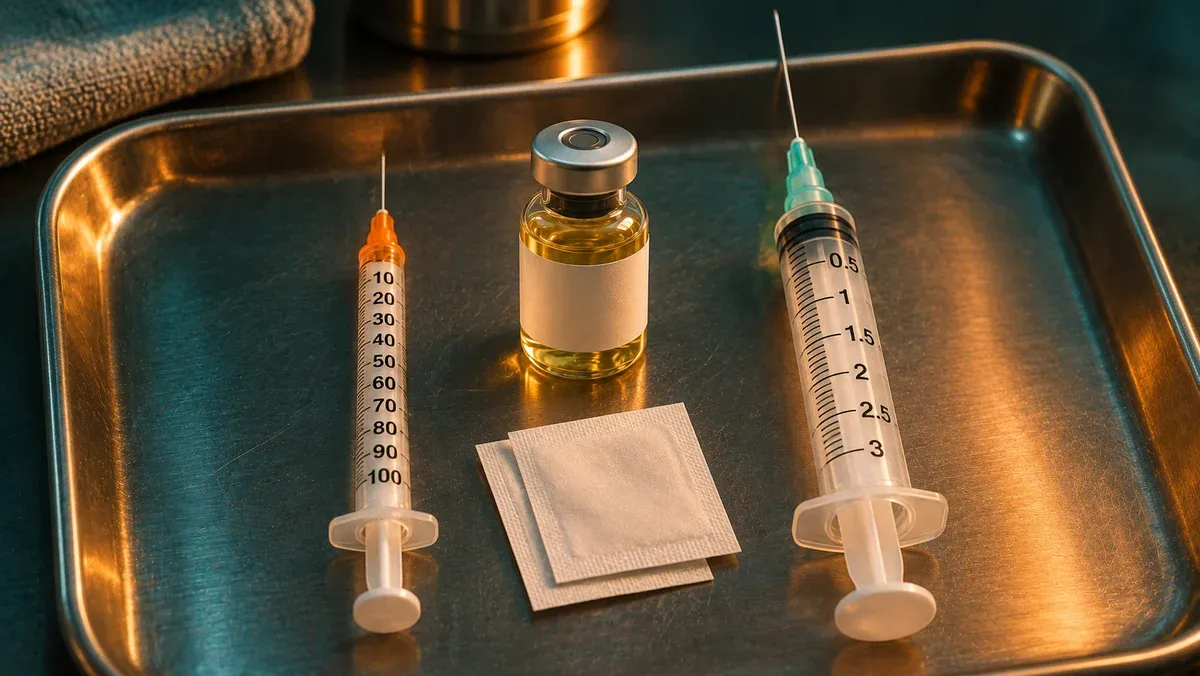
- 1Supplies: a 0.5 or 1 mL U-100 insulin syringe with a fixed 27 to 30 gauge half-inch needle, or a 1 mL syringe with an 18 gauge drawing needle and a separate 27 to 30 gauge injection needle; two alcohol swabs; sharps container.
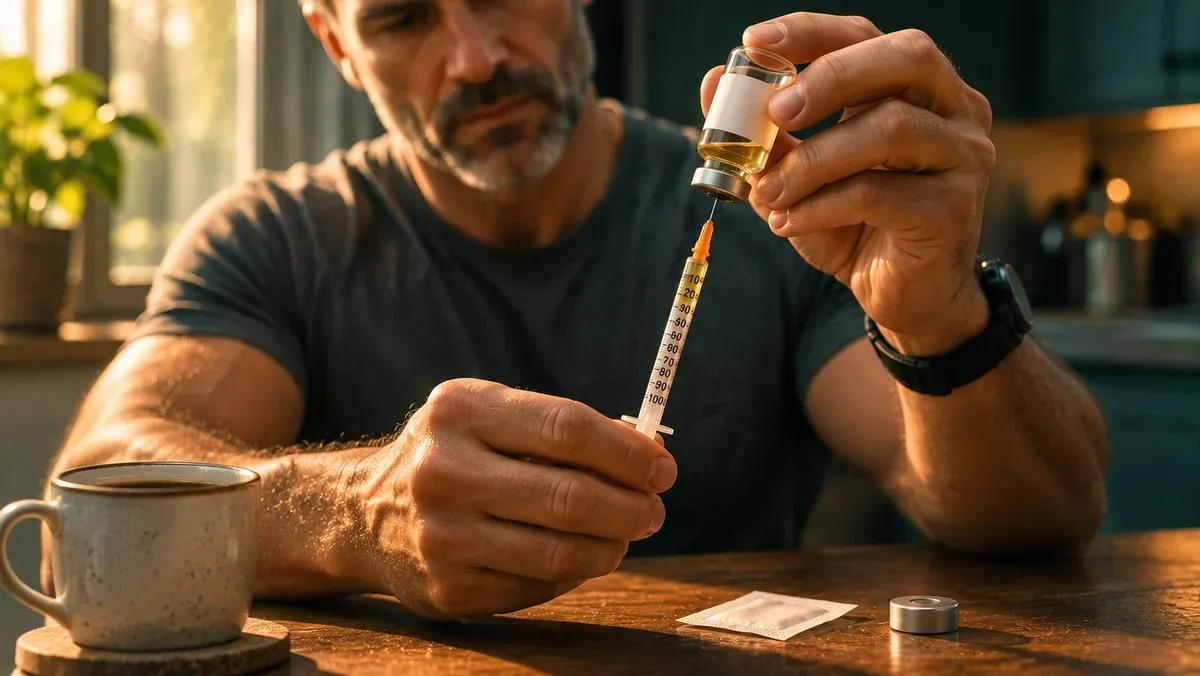
- 2Draw. Cottonseed oil through a 29 gauge needle is slow; let the vial reach room temperature and draw patiently, or draw with an 18 gauge and swap needles. 100 mg of the 200 mg/mL strength is 0.5 mL, 50 units on the insulin scale.
- 3Site. Two inches to either side of the navel, below it, or the outer thigh. Avoid the two inches around the navel itself and any bruise, scar or lump.
- 4Pinch a fold of fat, insert the needle at 90 degrees to the fold, or 45 degrees in a lean man, up to the hub.
- 5Push slowly, about 10 seconds for 0.5 mL. Hold a few seconds, withdraw, press with a swab, do not rub.
- 6Rotate: a new spot each injection, at least an inch from the last, working around the abdomen over the weeks.
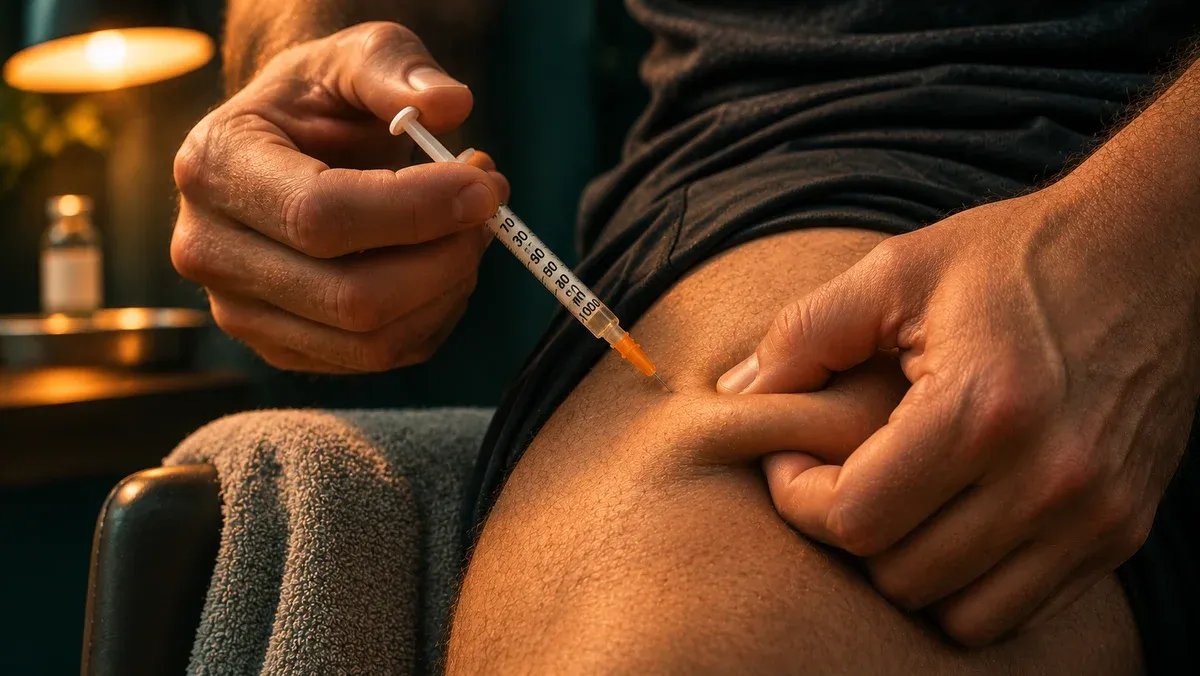
Aspiration is unnecessary in subcutaneous fat. A small, firm lump for a few days is the oil depot and is normal; spreading redness, warmth or a lump that grows is not, and the injection guide covers the warning signs and the intramuscular technique for comparison.
Dose and Volume
The subcutaneous route favours small volumes. Clinics that use it typically prescribe 50 to 100 mg weekly, or 40 to 60 mg twice weekly, which is the Endocrine Society's weekly regimen split into the smallest convenient injections. A 150 or 200 mg biweekly dose can be given subcutaneously by splitting it between two sites, but most prescribers who switch the route also switch the schedule, because the point of the change is steadier levels.
Common subcutaneous schedules at 200 mg/mL
50 mg
Once weekly
0.25 mL (25 units)
80 mg
40 mg twice weekly
0.2 mL (20 units)
100 mg
Once weekly
0.5 mL (50 units)
100 mg
50 mg twice weekly
0.25 mL (25 units)
150 mg
75 mg twice weekly
0.375 mL (37.5 units)
Blood work follows the same rules as any schedule: a trough measurement at about six weeks, then hematocrit, PSA and testosterone at three to six months. The dose arithmetic is on the 200 mg page; the monitoring schedule is in the TRT guide.
Who Should Not Switch on Their Own
- 1Anyone on a prescription that specifies intramuscular: the change is a prescriber's decision because it is off label, and the trough should be rechecked after switching.
- 2Men on anticoagulants: subcutaneous bruising is more visible, and the label warns of increased sensitivity to oral anticoagulants on testosterone.
- 3Men with very little abdominal fat: a half-inch needle can reach muscle, which is harmless but defeats the purpose; the thigh fold or a 45 degree angle is used.
- 4Anyone treating a lump, redness or pain that is worsening: that needs a visit, not a change of route.
Side effects of the hormone itself, the hematocrit, blood pressure and estradiol effects, do not depend on the route; what the route changes is the shape of the curve. Those effects are on the side effects page.
Frequently Asked Questions
Yes, off label. The cypionate labels specify intramuscular injection, but a 2017 cohort of 63 men on weekly subcutaneous doses all reached normal levels, a 2022 review found comparable levels to intramuscular at similar doses, and Xyosted is an approved subcutaneous enanthate product.
Published cohorts and the 2022 review report comparable mean testosterone levels at similar doses, with a flatter curve. No large randomized trial has compared the routes directly.
A 27 to 30 gauge half-inch needle, usually on a 0.5 or 1 mL insulin syringe. Oil draws slowly through it; drawing with an 18 gauge needle and swapping is common.
Into a pinched fold of fat on the abdomen, two inches or more from the navel, or on the outer thigh, rotating sites each time.
Most clinics keep each injection to 0.25 to 0.5 mL (50 to 100 mg of the 200 mg/mL strength). Larger doses are split between two sites or, more often, into twice-weekly injections.
In the 2017 cohort all 22 men who switched from intramuscular preferred the subcutaneous route, and the 2022 review describes less discomfort. The usual aftermath is a small firm lump for a few days rather than muscle soreness.
Cypionat.com is an independent educational resource. We are not affiliated with Pfizer, Azurity, Antares or any manufacturer, pharmacy or clinic. This content is for informational purposes only and does not constitute medical advice. Images on this site are illustrative artwork made for editorial purposes; they do not show real products, packaging or labels and are not an advertisement or an offer to sell.
Editorial
Author
Comments (0)
Be the first to comment on this article.