Testosterone Cypionate vs Propionate: Half-Life, Dosing and Availability
Testosterone cypionate vs testosterone propionate is a comparison between the ester that every US pharmacy stocks and the ester that none of them does. Propionate was the first injectable testosterone, marketed in 1937; cypionate followed in 1951 and replaced it in medical practice because one injection lasts a week or two instead of a day or two. Today propionate survives in the US only as a compounded product, in the UK as an unlicensed special, and in non-medical use, where its fast clearance is the reason people choose it.
This article sets the two esters side by side: structure, half-life, how often each is injected, what the labels and guidelines say, availability, injection pain and the reasons each is chosen. Sources: the Depo-Testosterone label (Pfizer, revised October 2025), the Italian SIAMS/SIE guideline tables (2022), a 1986 pharmacokinetic study of propionate, a 2016 pharmacology review in Translational Andrology and Urology, and FDA and NHS product records.
The Two Esters
An ester is a fatty-acid chain attached to the testosterone molecule at the 17-beta position. The chain makes the molecule oil-soluble, so it stays in the muscle depot and is released slowly; enzymes in the blood then clip the chain off and free the hormone. Free testosterone has a circulating half-life of about 10 minutes, which is why medical products attach an ester.
Structure and content
Ester
Propanoic acid, 3 carbons, straight chain
Cyclopentylpropionic acid, 8 carbons including a ring
Testosterone by weight
About 84%
About 70%
100 mg of ester delivers
About 84 mg testosterone
About 70 mg testosterone
First marketed
1937 (Schering, Testoviron)
1951 (Upjohn, Depo-Testosterone)
The longer the chain, the slower the release. Propionate's three carbons make it the shortest ester in common use; cypionate, at eight carbons including a ring, and enanthate, at seven, are the two long esters US guidelines treat as interchangeable, compared on the cypionate vs enanthate page.
Half-Life and Dosing Frequency
Pharmacokinetics by source
Half-life
20 hours (SIAMS 2022); 0.8 to 2 days in secondary reference tables
Approximately 8 days (Depo-Testosterone label)
Duration of one injection
3 to 4 days (historical product data)
Levels near baseline by day 14 after 200 mg
Typical regimen
100 mg every 2 days (SIAMS); historically 10 to 50 mg two or three times a week
50 to 400 mg every 2 to 4 weeks (label); 75 to 100 mg weekly or 150 to 200 mg every 2 weeks (Endocrine Society)
Injections per month
10 to 15
2 to 4
The main published pharmacokinetic study of propionate in men, from 1986, gave 25 mg of labelled propionate to normal volunteers: the labelled hormone held at 2 to 4 ng/mL between 3 and 36 hours. No head-to-head crossover study of propionate against cypionate exists; the comparison tables in the guidelines are assembled from separate studies.
What the short half-life means in practice: propionate reaches a steady level within a few days of starting and falls back within a few days of stopping. Cypionate takes four to five weeks of weekly injections to reach steady state and a month to clear, as set out on the half-life page.

Availability
- 1United States: every testosterone propionate application in the FDA database is discontinued, including approvals from 1973 and 1974; no product is marketed. GoodRx lists the 25 mg/mL vial as discontinued with no price. Propionate is available only from compounding pharmacies, whose products are not FDA-approved. It is Schedule III like every testosterone ester.
- 2United Kingdom: a 100 mg/2 mL ampoule exists in the NHS dictionary as an unlicensed "special order" product.
- 3Elsewhere: the historical brands, Testoviron among them, were propionate; today's Testoviron Depot is enanthate, a common source of confusion.
- 4Cypionate: 100 and 200 mg/mL from Pfizer (brand and authorized generic) and eight other generic makers, in 1 and 10 mL vials.
Cottonseed oil is the cypionate carrier; propionate was sold in several oils and, by 1950, in an aqueous suspension. The cypionate generics and their approval dates are on the Depo-Testosterone page.
Injection Pain
Propionate is "often a painful injection, attributed to its short ester chain", in the words of a widely cited non-medical handbook. No peer-reviewed study compares injection-site pain between esters, so the reputation rests on user reports, which are consistent: short esters in low-volume, high-frequency injections produce more soreness than long esters injected every one or two weeks. Cypionate's label lists inflammation and pain at the injection site among adverse reactions, and warns that cypionate "should not be used interchangeably with testosterone propionate because of differences in duration of action"; the technique that reduces it is on the injection guide.
Blood Levels: Same Hormone, Different Curve
Both esters release testosterone itself. At equal weekly doses, the average level over a week is similar; what differs is the amplitude. In the Azmiro label study, a 200 mg cypionate injection raised testosterone by a mean 758 ng/dL above baseline, peaking at about day 3, and is near baseline by day 14. Propionate injected every other day holds a narrower band, because each small dose has mostly cleared before the next arrives.
Why each is chosen
Medical replacement
Not used in the US; the Italian SIAMS table lists it, US guidelines do not
Standard of care; label and guideline dosing
Steady levels
Every-other-day injections, little swing
Weekly or twice-weekly injections approach the same steadiness
Fast start and stop
Days
Weeks
Convenience
Ten or more injections a month
Two to four
In non-medical use the fast clearance is the attraction: a short cycle ends within days of the last injection, and a dose can be changed quickly. That is pharmacology, not a recommendation; the dose-response data for testosterone esters are on the bodybuilding page, and the risks that rise with dose on the side effects page.
Which One for TRT
For prescribed replacement the question answers itself: propionate is not an approved product in the United States, no US guideline lists it, and a clinic that offers it is offering a compounded drug. Cypionate, enanthate and the undecanoate injection are the options the Endocrine Society and the AUA describe. For a man who wants steadier levels than biweekly cypionate gives, the guideline route is weekly or twice-weekly cypionate, or the subcutaneous schedule on the subcutaneous page, not a switch to a shorter ester.
Frequently Asked Questions
The ester chain. Propionate is a 3-carbon ester with a half-life of about 20 hours to 2 days, injected every 1 to 3 days; cypionate is an 8-carbon ester with a half-life of about 8 days, injected every 1 to 2 weeks. Both release the same hormone.
Not currently. All US propionate approvals, dating from the 1970s, are discontinued, and no product is marketed. It is available only from compounding pharmacies, whose products are not FDA-approved.
Propionate has a long-standing reputation for injection pain attributed to its short ester, though no controlled comparison exists. Cypionate's label lists inflammation and pain at the injection site among adverse reactions.
Both deliver testosterone, so a prescriber could in principle change esters, but propionate is not an approved US product and is not listed in US TRT guidelines. Steadier levels are usually reached by injecting cypionate more often.
Every 1 to 3 days. The Italian guideline table gives 100 mg every 2 days; historical medical dosing was 10 to 50 mg two or three times a week.
At the same weekly dose the average testosterone level is similar. Propionate's advantages are a faster start and stop and a narrower swing between injections; its costs are ten or more injections a month and more injection pain.
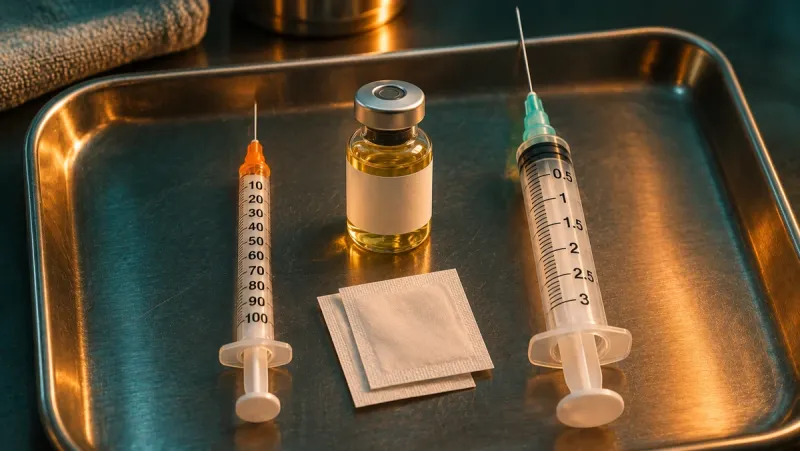
Cypionat.com is an independent educational resource. We are not affiliated with Pfizer, Azurity, Antares or any manufacturer, pharmacy or clinic. This content is for informational purposes only and does not constitute medical advice. Images on this site are illustrative artwork made for editorial purposes; they do not show real products, packaging or labels and are not an advertisement or an offer to sell.
Editorial
Author
Comments (0)
Be the first to comment on this article.